Cruise Ships
Multi-venue bingo across decks and lounges under one login — caller-led showtime or fully automated sea-day sessions.
Your sailing today, before and after
The same lounge showtime and deck sessions, run two different ways.
| Before | With RojoBingo | |
|---|---|---|
| Main lounge showtime | The cruise director calls from handwritten notes, tallying winners by hand | A tablet console runs the whole show — call, claims queue, confirm — with results on two TVs before the lights come up |
| Deck and bar sessions | Bar staff run a separate paper game with its own cash box | The same login runs every satellite venue; terminals sell seats and the engine calls itself |
| Turnaround day | Next sailing's program is rebuilt from scratch, and crew access is re-issued by hand | Copy this sailing's templates in a tap, and invite the next crew rotation by e-mail with a built-in expiry |
| Multi-venue reporting | Each lounge and bar reconciles its own cash separately | One organization, one report per cashier, across every venue on the ship |
| Connectivity | A dropped connection mid-game means restarting from a tally sheet | Every ball, sale and claim lives on the server; a kiosk that drops shows a reconnect screen and resumes exactly where it left off |
The stack for every venue on the ship
Two products cover every venue on the ship under one operation.
How a sailing runs
Four moments of a sailing, from main showtime to turnaround day.
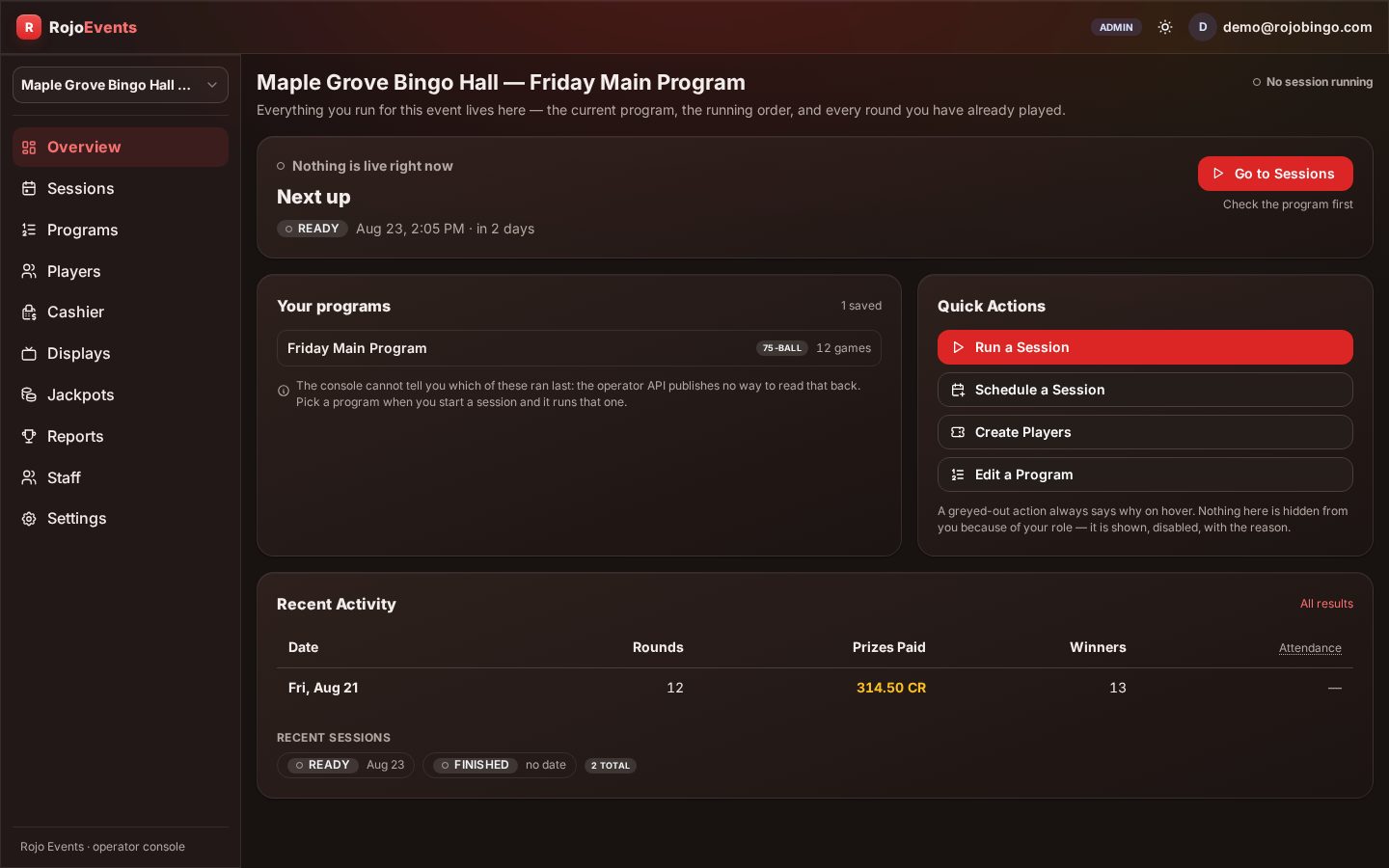
Sea-day main lounge
Caller-run by default: one tap per ball, claims queue holds the game until Confirm — or switch on auto-call for a quieter matinee.
A flashboard and a jackpot screen pair in seconds — no ship AV crew required.
Winners, sales and the cashier report are ready the moment the last game ends.
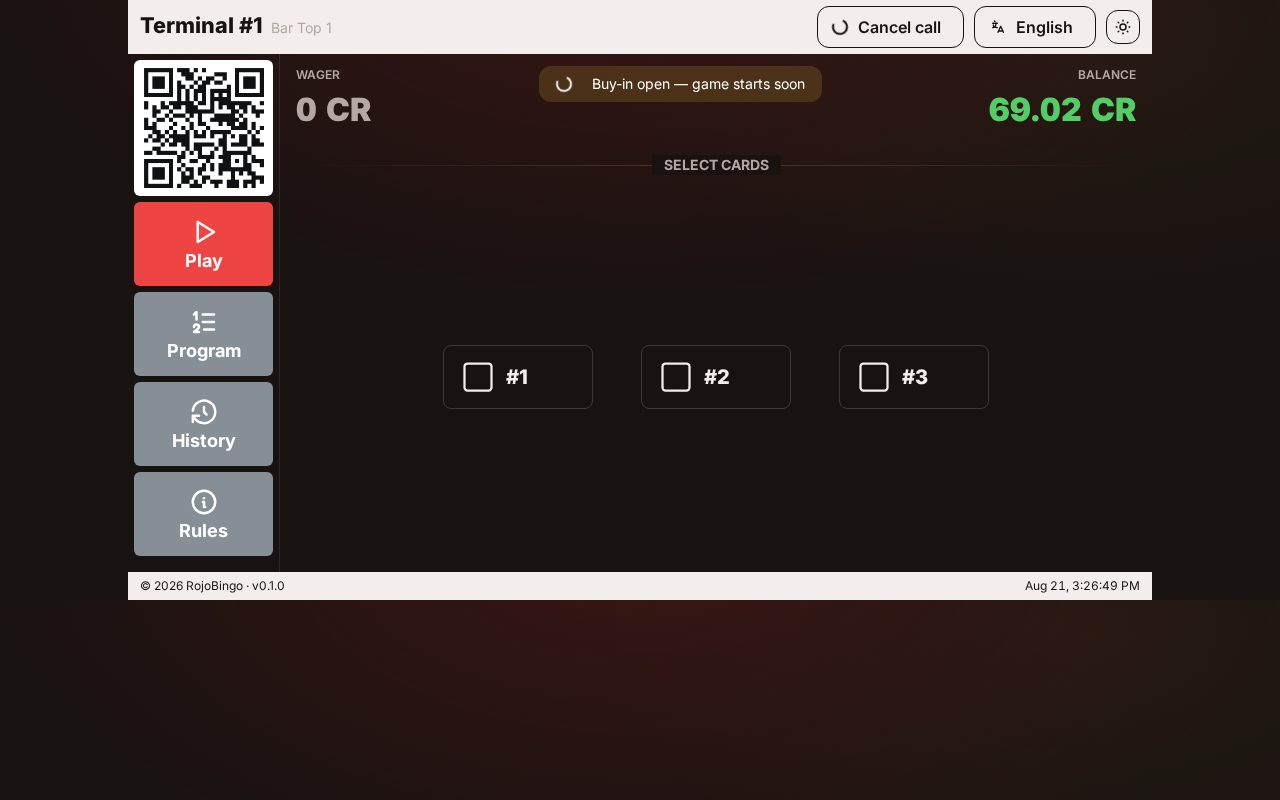
Deck and bar satellites
Cards are free to pick while sales are open, charged the moment the game locks.
No caller assigned to the pool bar — the engine calls, verifies and pays on its own.
Staff move between the main lounge and any deck bar from the same login, with TVs following each venue's own event.
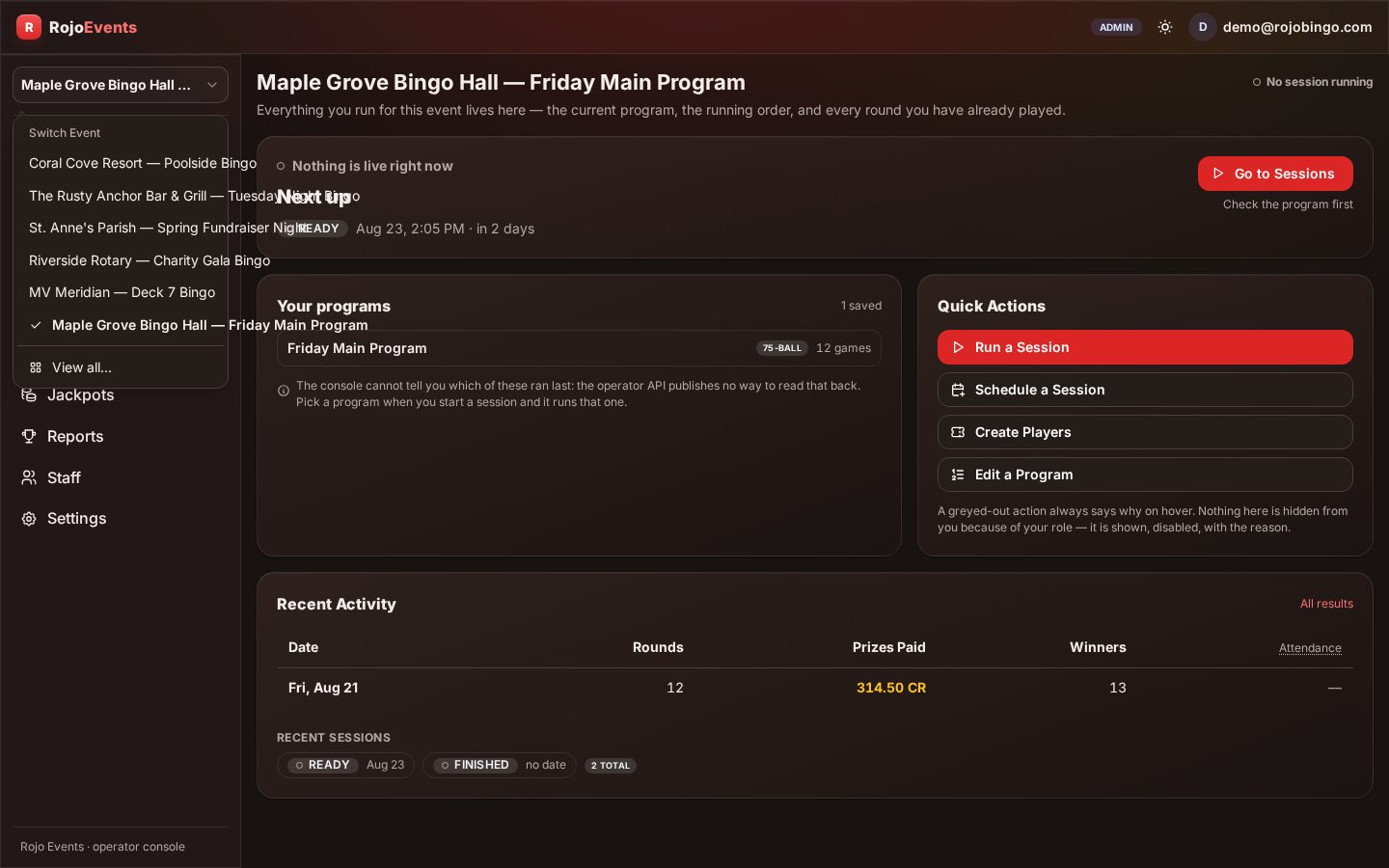
One switcher, every venue.
Staying resilient at sea
Bingo at sea depends on the ship's network — RojoBingo doesn't pretend otherwise. What it does guarantee is that nothing is lost when a connection drops.
Balls called, seats sold and claims made are recorded the instant they happen, not held on a kiosk.
Players see a clear offline state and reconnect automatically once the network returns.
Whoever is running the game picks up exactly where it was — no re-entering scores, no lost sales.
The platform is resilient to connectivity drops. It still requires a working connection to run — this is not an offline-capable system.
Turnaround day
Next sailing's programs start from this one, copied in a tap instead of rebuilt from nothing.
Roles are assigned by e-mail invite with a built-in expiry, so a crew member who signs off loses access on schedule.
Whoever staffs bingo next rotation opens a console they may already know from a previous ship.
A sample sailing program
A sea-day program and a staged evening show, from the same pattern library.
Sea-day program — 75-ball
| Game # | Type | Pattern | Jackpot | Notes |
|---|---|---|---|---|
| 1 | 75-ball | Four Corners | — | Warm-up, shared win |
| 2 | 75-ball | Top Line | Moneyball | Bonus number drawn from the round's fairness seed |
| 3 | 75-ball | Any Diagonal | — | Shared win |
| 4 | 75-ball | Postage Stamp | — | Shared win |
| 5 | 75-ball | Letter X | Moneyball | Second moneyball game of the day |
| 6 | 75-ball | Layer Cake | — | Shared win |
| 7 | 75-ball | Crazy Kite | Progressive | Sailing-long pool, carries every day until won |
| 8 | 75-ball | Blackout (Coverall) | — | Session finale, shared win |
Evening showtime — 90-ball, staged format
| Game # | Type | Pattern | Jackpot | Notes |
|---|---|---|---|---|
| 1 | 90-ball | Top Line | — | Stage one, shared win |
| 2 | 90-ball | Two Lines | — | Stage two, shared win |
| 3 | 90-ball | Full House | — | Stage three, first-to-call finale |
Programs are fully configurable — ball types, patterns, prices and payouts are yours to set.
FastTrack runs short, fast-paced games at the pool bar between main sessions — see how it works on RojoConsole For Venues.
Your configuration
Our concierge team sets this up with you — this is exactly what a sailing looks like on the platform.
| Setting | Recommended for your sailing |
|---|---|
| Money model | Credit |
| Automation | Caller-run showtime mains + fully automated satellites |
| Call pace | Set per venue — relaxed at satellites, showtime pace in the lounge |
| Winner mode | Shared, with first-to-call on staged finales |
| Ball types | 75-ball in the main lounge, 90-ball for staged evening shows, 30-ball at the pool bar — each its own separate program |
| Jackpots | Moneyball + sailing-long progressive |
| Session cadence | Per-sailing templates, copied at turnaround |
| Languages | EN/ES/FR |
Every role is invited by e-mail with a built-in expiry, matched to the crew's rotation.
Your first session, step by step
- Organization and events — One event for each venue on the ship.
- Money model — Credit sales across every venue.
- Programs — Build this sailing's programs, or copy last sailing's templates.
- TVs paired — Pair the main lounge's two TVs.
- Terminals live — Turn on terminals at the deck and bar satellites.
- Crew invited — Invite this rotation's crew by e-mail, with a built-in expiry.
- Turnaround day — At the next turnaround, copy the same templates again.
Who's on shift
| On shift | What they do | |
|---|---|---|
| Sea-day main lounge (caller-run or auto-called) | A director or operator, plus a cashier | Runs the console — by hand or with auto-call — and confirms claims |
| Deck & bar satellites (fully automated) | One cashier per venue | Sells seats or credits and approves cash-outs; the engine runs the game |
What this does for the business
- Package or credit sales across every venue, from the same organization.
- Charge-at-lock terminal seats keep deck bars turning over without a cashier re-selling each round.
- A sailing-long progressive gives guests a reason to keep coming back to the lounge all week.
- LiveStream reaches guests watching from their cabin instead of the lounge floor.
You set your prices and payouts and keep your revenue. Straightforward per-player pricing for digital events — sell as many cards per player as you like. No cut of prizes — we license the software.
Operators run under the rules and regulations of their local jurisdiction.
Most ships are live within days of onboarding — we help set up your first sailing's programs and venue roles, and crew are invited by e-mail before they ever open the console.
What cruise ships ask before switching
What happens if we lose connectivity at sea?
Nothing is lost — every ball, sale and claim lives on the server, and kiosks reconnect where they left off. A working connection is still required (see Staying resilient at sea above).
Can the main lounge and deck bars run at the same time?
Yes. Every venue on the ship runs its own event under the same organization, with staff switching between them from one login.
Our crew rotates every few months — how do we manage access?
Invite each role by e-mail with a built-in expiry. Access ends on schedule when a crew member signs off — nobody has to remember to revoke it.
Do you support multiple currencies and languages?
Kiosks and TVs run in English, Spanish and French; pricing and payouts are set in whatever terms your onboard economy already uses.
Bring RojoBingo to your venue
RojoConsole runs the game — caller-run or fully automated — with streaming and loyalty on the same platform. Concierge launch in days.